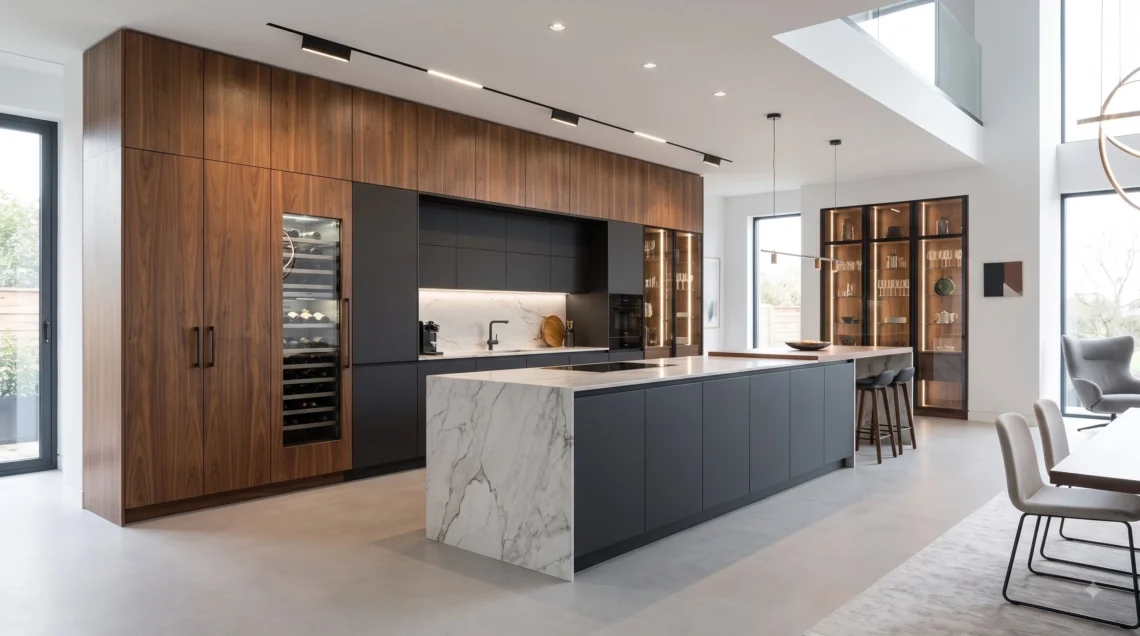
Modern kitchen cabinets are no longer just storage — they define the visual character of the entire kitchen. From warm walnut cabinetry and handleless matte finishes to dramatic two-tone combinations and floor-to-ceiling storage, today’s luxury kitchens balance clean aesthetics with practical functionality.
This guide walks through 25 modern cabinet design ideas, explains what makes a kitchen read as “luxury” rather than just “new,” and gives you a framework for choosing the right style, color, and material for your own space — whether that’s a compact city kitchen or a sprawling open-plan layout.
At a glance:
- The defining features of modern luxury cabinetry are restraint, not decoration
- Color and material consistency matters more than any single trend
- The right cabinet choice depends heavily on kitchen size, light, and layout
- Small design decisions (hardware, sightlines, lighting) separate an “expensive-looking” kitchen from an ordinary one
What Makes a Kitchen Cabinet Design Look Modern and Luxurious?
Before jumping into specific styles, it helps to understand the underlying principles that separate a genuinely luxurious modern kitchen from one that simply has new cabinets.
- Clean lines. Flat or slab-front doors with minimal ornamentation photograph well and age well — ornate detailing tends to look dated faster.
- Minimal or hidden hardware. Handleless (push-to-open or integrated channel) cabinets create an uninterrupted visual surface.
- Integrated appliances. Panel-ready refrigerators, dishwashers, and range hoods keep the cabinetry line unbroken.
- Premium, consistent finishes. One or two finishes used deliberately reads as more expensive than five finishes used decoratively.
- A restrained color palette. Luxury kitchens rarely use more than two or three core tones.
- High-quality materials. Real wood veneer, natural stone, and quality laminates outperform low-grade materials even at a glance.
- Smart, concealed storage. Pull-out pantries, appliance garages, and drawer organization reduce visible clutter.
- Layered lighting. Under-cabinet, toe-kick, and interior cabinet lighting do as much for “luxury” perception as the cabinets themselves.
- A statement island. Often the visual anchor of the whole room, especially in open-plan homes.
With those principles in mind, here are 25 ways to apply them.
25 Modern Kitchen Cabinet Design Ideas
1. Handleless Matte Cabinets
A fully handleless kitchen with a matte (not gloss) finish is currently one of the most requested modern looks. The absence of hardware creates an unbroken plane, while the matte surface hides fingerprints far better than gloss.
Best for: Minimalist and Scandinavian-influenced kitchens.
Design tip: Use push-to-open or a recessed finger-pull channel rather than visible handles.
Watch out for: Matte laminate can show scratches more visibly than gloss over time — choose a scratch-resistant grade.
2. Warm Wood and White Cabinets
Pairing white upper cabinets with natural or stained wood lower cabinets keeps a kitchen bright while avoiding the sterile, all-white look that can feel clinical.
Best for: Kitchens with limited natural light that still need to feel open.
Design tip: If your kitchen doesn’t get much sun, pair warm-white cabinets with light oak rather than a stark white-and-gray combination — the wood adds visual warmth without making the room feel heavy.
3. Floor-to-Ceiling Cabinetry
Extending cabinets to the ceiling eliminates the dust-collecting gap above standard-height uppers and dramatically increases storage.
Best for: Kitchens with 9-foot or higher ceilings.
Design tip: Reserve the topmost shelf for rarely used items, since it typically requires a step stool.
4. Two-Tone Kitchen Cabinets
Using two complementary colors — often on uppers versus lowers, or island versus perimeter — adds visual depth without introducing clutter. Common combinations:
- White + walnut
- Black + natural oak
- Greige + wood
- Navy + white
Best for: Kitchens that want contrast without pattern.
Design tip: Keep the darker tone below eye level; it visually “grounds” the room.
5. Dark Luxury Kitchen Cabinets
Charcoal, black, deep green, and dark walnut cabinets have moved from a bold statement to a mainstream luxury choice, especially paired with brass or matte-black hardware.
Best for: Larger kitchens with strong natural or artificial lighting.
Watch out for: In small or dim kitchens, an all-dark palette can feel cramped — balance with light countertops or a skylight.
6. Minimalist Flat-Panel Cabinets
Flat-panel (slab) doors with no visible grain or detailing are the backbone of most contemporary kitchens.
Best for: Nearly any modern kitchen; this is the most versatile modern door style.
Design tip: Because the door itself is so plain, the quality of the finish (not the design) is what will make it look premium or cheap.
7. Soft Greige Cabinets
Greige — a blend of gray and beige — has overtaken pure white as the “safe but sophisticated” neutral for cabinetry.
Best for: Buyers who want a neutral palette with more warmth than gray but more restraint than beige.
Design tip: Pair with brushed brass or warm gold hardware to avoid the palette feeling flat.
8. Natural Oak Cabinets
Light, natural oak (rather than heavily stained wood) has become a defining material of the current “quiet luxury” kitchen trend.
Best for: Warm contemporary and Scandinavian-inspired kitchens.
Design tip: Pair with white oak flooring in the same tone family to avoid a mismatched “wood-on-wood” look.
9. Black and Wood Combination
Matte black cabinetry combined with natural wood open shelving or a wood island creates high contrast without feeling cold.
Best for: Kitchens that want a dramatic but still warm aesthetic.
Design tip: Limit black to roughly half the cabinetry; using it everywhere can visually shrink the room.
10. Glossy Statement Cabinets
A high-gloss finish — usually in white, cream, or a bold color — reflects light and can make a kitchen feel larger and more polished.
Best for: Small or low-light kitchens.
Watch out for: Gloss shows fingerprints and smudges more readily than matte; factor in maintenance.
11. Integrated Appliance Panels
Cabinet-front panels that conceal the refrigerator, dishwasher, and sometimes the range hood create a seamless, uninterrupted cabinet run.
Best for: Anyone prioritizing a clean, gallery-like kitchen aesthetic.
Design tip: This is one of the highest-impact luxury upgrades, but it requires panel-ready appliances specified early in the design process.
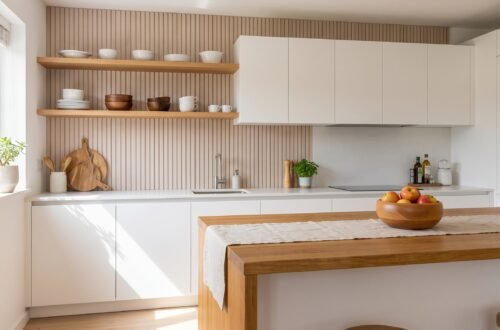
12. Open Shelving Accents
A small section of open wood or floating shelving, mixed with closed cabinetry, softens an otherwise fully enclosed kitchen.
Best for: Kitchens that want warmth and personality without going fully open-shelf.
Design tip: Keep open shelving to one wall or one section — using it throughout creates visual clutter and dust exposure.
13. Vertical Grain Wood Paneling
Cabinets with a deliberate vertical wood grain (rather than horizontal or random) add a subtle architectural rhythm to a kitchen. Best for: Contemporary kitchens that want texture without pattern.
14. Stone-Look and Textured Cabinet Fronts
Cabinet fronts finished to resemble natural stone or featuring a subtle textured laminate add tactile interest that a flat matte finish doesn’t provide. Best for: Kitchens that want a natural-material feel without the cost of full stone cabinetry.
15. Curved Cabinet Islands
Rounded or curved island edges soften an otherwise linear kitchen and have become a signature feature of high-end contemporary design.
Best for: Open-plan kitchens where the island is a focal point.
Watch out for: Curved cabinetry is typically custom and costs meaningfully more than standard rectangular runs.
16. Monochromatic Cabinet Schemes
Using a single color across uppers, lowers, and the island — often in a muted tone like sage, taupe, or charcoal — creates a calm, cohesive look.
Best for: Buyers who want a timeless, non-trend-dependent kitchen.
Design tip: Vary the finish sheen slightly between elements (e.g., matte cabinets with a soft-gloss island) to avoid flatness.
17. Brass and Wood Detailing
Brushed or unlacquered brass hardware and trim paired with natural wood cabinetry is one of the defining combinations of the current luxury kitchen aesthetic.
Best for: Warm contemporary kitchens.
18. Waterfall Edge Cabinetry
Extending the countertop material down the sides of an island in one continuous piece (a “waterfall edge”) is a strong luxury signal, especially in stone or quartz.
Best for: Statement islands in larger kitchens.
Watch out for: This is a higher-cost detail due to material and fabrication requirements.
19. Concealed Pantry Walls
A full wall of floor-to-ceiling cabinetry that reads as a single architectural surface, with a hidden pantry or appliance garage behind one section, keeps the kitchen visually calm.
Best for: Kitchens that need heavy storage but want a minimal look.
20. Backlit Glass-Front Cabinets
A small run of glass-front upper cabinets with integrated interior lighting adds a display element without opening the whole kitchen to open shelving.
Best for: Kitchens that want to display glassware or ceramics as a design feature.
21. Textured Wood Slat Cabinetry
Fluted or slatted wood panels on an island base or a feature wall of cabinetry add dimension and a tactile, high-end feel.
Best for: Kitchens looking for a signature “wow” element.
22. Cream and Taupe Cabinetry
A softer alternative to stark white, cream and taupe cabinetry has become a leading choice for buyers who want warmth without committing to a bold color.
Best for: Traditional-leaning homes that still want a contemporary kitchen.
23. Mixed-Material Islands
An island finished in a different material entirely — such as a wood or stone cladding — while the perimeter uses standard cabinetry creates a furniture-like focal point.
Best for: Open-plan kitchens where the island is visible from living areas.
24. Compact Handleless Cabinets for Small Kitchens
Applying handleless design principles at a smaller scale — with lighter colors and reflective surfaces — is one of the most effective ways to modernize a compact kitchen.
Best for: Apartments, galley kitchens, and smaller renovations.
25. Custom Statement Cabinetry
Fully bespoke cabinetry — a unique color, an unusual material, or a one-off design detail specific to the homeowner — is ultimately what separates a true luxury kitchen from a well-executed standard one.
Best for: Buyers with a larger budget and a clear point of view on their space.
How to Choose the Right Cabinet Style
For small kitchens: Favor light colors, vertical cabinet lines, and reflective (gloss or semi-gloss) surfaces. Handleless designs and minimal visual clutter make a compact space feel larger.
For large kitchens: Larger spaces can support floor-to-ceiling cabinetry, dramatic dark colors, and statement materials that would overwhelm a smaller room.
For luxury kitchens: Prioritize natural stone, premium wood veneer, fully integrated appliances, and sophisticated hardware over any single trend — luxury reads through material quality more than style choice.
For minimalist kitchens: Handleless doors, flat panels, a neutral palette, and concealed storage keep the visual field as quiet as possible.
For warm contemporary kitchens: Oak, walnut, beige, and cream tones paired with warm lighting create a modern kitchen that still feels inviting rather than clinical.
Frequently Asked Questions About Modern Kitchen Cabinets
What is the most popular modern kitchen cabinet style?
Handleless, flat-panel cabinetry in a matte finish is currently the most widely adopted modern style, prized for its clean lines and minimal upkeep.
What colors make kitchen cabinets look luxurious?
Deep neutrals (charcoal, espresso, deep green), warm woods like walnut and oak, and soft greige tones tend to read as the most luxurious, especially when limited to two or three colors total.
Are handleless kitchen cabinets practical?
Yes, for most households. Push-to-open and finger-pull channel systems function well day-to-day, though very deep drawers can be slightly harder to open one-handed compared to a traditional pull.
What is the best cabinet color for a small kitchen?
Light, reflective colors — soft white, pale oak, light greige — combined with a gloss or semi-gloss finish generally make a small kitchen feel larger.
How do I make my kitchen look more expensive?
Focus on a restrained palette, full-height cabinetry, quality hardware (or handleless design), integrated appliances, and layered lighting rather than adding more decorative elements.
Are wood cabinets suitable for modern kitchens?
Yes. Natural, lightly finished wood — especially oak and walnut — is one of the defining materials of the current modern kitchen aesthetic, particularly when paired with a simpler, flat-panel door style.
What is better: matte or glossy kitchen cabinets?
Matte is generally preferred for its softer look and lower visible maintenance; gloss is better suited to smaller or darker kitchens that benefit from extra light reflection.
How long should modern kitchen cabinets last?
Well-built cabinetry with quality boxes and hardware typically lasts 20–30 years, though door fronts and finishes are sometimes updated sooner as styles evolve.


One comment on “Modern Kitchen Cabinet Design Ideas: 25 Luxury & Contemporary Inspirations”